

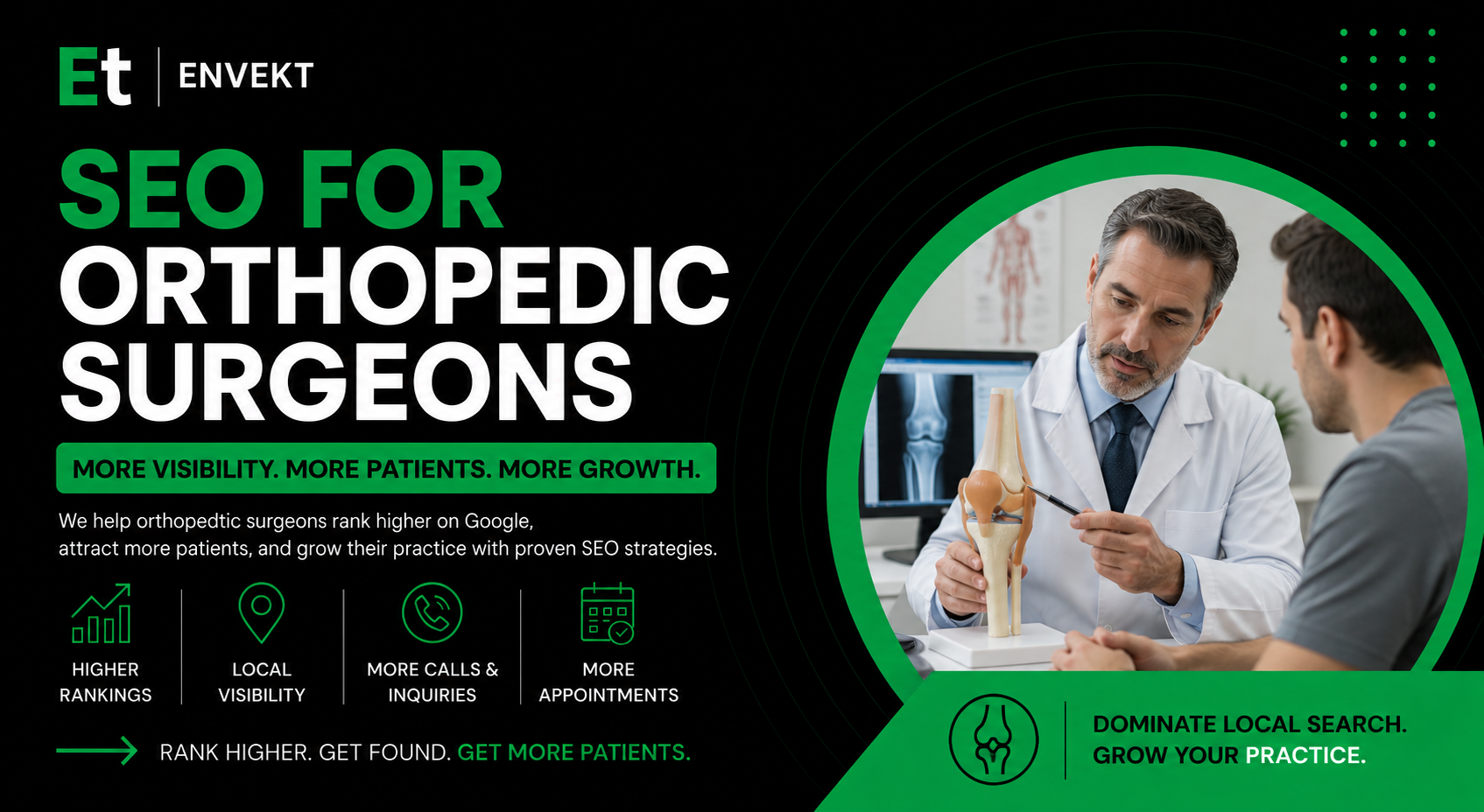
More patients search Google before choosing an orthopedic surgeon, making online visibility more important than ever. With growing competition, ranking on the first page of Google helps your practice attract more qualified patients, build trust, and increase appointment bookings. At Envekt, we help orthopedic surgeons improve their search rankings and grow their practice with proven SEO strategies.
Why Orthopedic Surgeons Need SEO
Today, most patients begin their healthcare journey online. Whether they are experiencing persistent knee pain, a sports injury, or chronic back discomfort, their first step is often a Google search—not a phone call or a referral. If your orthopedic practice doesn’t appear in those search results, you’re likely missing opportunities to attract new patients.
Patients Search for Symptoms Before Choosing a Surgeon
Many people search for symptoms such as “knee pain when walking,” “shoulder pain treatment,” or “best doctor for hip replacement” before they know which specialist they need. A strong SEO strategy helps your website appear for these searches, guiding potential patients to your practice early in their decision-making process.
Patients Compare Orthopedic Surgeons Online
Before scheduling an appointment, patients often compare multiple orthopedic surgeons. They evaluate websites, patient reviews, credentials, treatment options, and overall online presence. Ranking prominently in search results with a professional, informative website helps build credibility and increases the likelihood of being chosen.
Mobile Searches Continue to Grow
A large percentage of healthcare-related searches are performed on smartphones. Patients frequently search for orthopedic care while at work, at home, or even after an injury. An SEO-optimized, mobile-friendly website ensures your practice is easy to find and navigate on any device.
Improve Google Maps Visibility
When someone searches for terms like “orthopedic surgeon near me” or “bone specialist nearby,” Google often displays local map results before standard listings. Local SEO helps your practice appear in these valuable Google Maps results, making it easier for nearby patients to discover and contact your clinic.
Build Trust Through Online Reviews
Positive patient reviews influence both search rankings and patient decisions. People naturally trust orthopedic surgeons with strong ratings and authentic testimonials. SEO includes reputation management strategies that encourage positive reviews, helping establish trust and improve local visibility.
Generate More Appointment Requests
The primary goal of SEO is to connect your practice with people actively searching for orthopedic care. By increasing your visibility for high-intent keywords, SEO drives more qualified visitors to your website, leading to more appointment requests through online forms and phone calls.
Reduce Dependence on Referrals
While physician referrals remain important, relying solely on them can limit growth. SEO creates an independent source of patient acquisition by attracting individuals who are actively searching online for orthopedic services in your area.
Lower Long-Term Marketing Costs
Unlike paid advertising, which stops producing results when your budget runs out, SEO continues delivering organic traffic over time. Although it requires an upfront investment, it often provides a lower cost per patient acquisition and stronger long-term return on investment.
Benefits of SEO for Orthopedic Surgeons
A well-executed SEO strategy delivers lasting advantages that help orthopedic surgeons grow their practices, attract more patients, and strengthen their online reputation.
Higher Google Rankings
Appearing on the first page of Google significantly increases your visibility. Higher rankings help your practice stand out from competitors and attract patients who are actively searching for orthopedic care.
More Qualified Website Traffic
SEO targets keywords used by people looking for orthopedic treatments and specialists. This brings highly relevant visitors to your website who are more likely to become patients.
More Appointment Requests
As your website attracts more qualified traffic, you’ll receive more appointment requests through contact forms, online booking systems, and consultation inquiries.
Increased Phone Calls
Many patients prefer calling directly after finding a trusted orthopedic surgeon online. Optimized local SEO and click-to-call features make it easier for prospective patients to contact your practice immediately.
Better Google Maps Visibility
Local SEO improves your presence in Google Maps and local search results, helping nearby patients discover your clinic when searching for orthopedic services in their area.
Higher Return on Investment (ROI)
SEO generates consistent organic traffic without paying for every click. Over time, this leads to a lower cost per patient acquisition compared to many traditional advertising methods.
Stronger Brand Authority
Publishing helpful, accurate content about orthopedic conditions and treatments positions your practice as a trusted authority. This builds confidence among prospective patients and strengthens your reputation.
Long-Term Patient Acquisition
Unlike short-term marketing campaigns, SEO continues working long after optimization efforts begin. As your rankings improve, your website consistently attracts new patients month after month.
Better Online Reputation
SEO works alongside reputation management by encouraging patient reviews, showcasing testimonials, and highlighting your expertise. A strong online reputation increases patient trust and improves conversion rates, making it easier to turn website visitors into booked appointments.
How SEO for Orthopedic Surgeons Works
A successful SEO strategy for orthopedic surgeons combines multiple techniques to improve your website’s visibility, attract qualified patients, and increase appointment bookings. Each step plays an important role in helping your practice rank higher in Google search results and outperform local competitors.
Keyword Research
Keyword research is the foundation of every successful SEO campaign. It identifies the search terms potential patients use when looking for orthopedic care, allowing you to create content that matches their needs and search intent.
Examples of high-intent keywords include:
- Orthopedic surgeon near me
- Knee replacement surgeon
- Sports injury doctor
- Hip replacement specialist
- Spine surgeon
- Shoulder surgeon
- Orthopedic clinic near me
- Bone and joint specialist
- Orthopedic doctor for arthritis
- Best orthopedic surgeon in [City]
Targeting a mix of service-based, location-specific, and informational keywords helps your website attract patients at every stage of their decision-making journey.
Local SEO
Most orthopedic practices serve patients within a specific geographic area, making local SEO one of the most important aspects of your digital marketing strategy.
A strong local SEO campaign includes:
- Optimizing your Google Business Profile with accurate practice information, photos, services, and business hours.
- Maintaining NAP consistency (Name, Address, and Phone Number) across your website and online listings.
- Building citations on trusted healthcare and local business directories.
- Listing your practice in reputable local directories to improve credibility and local search visibility.
- Creating location-specific pages if you serve multiple cities or regions.
These efforts increase your chances of appearing in Google’s Local Pack and Google Maps when patients search for nearby orthopedic services.
On-Page SEO
On-page SEO ensures that every page on your website is optimized for both search engines and users.
Key on-page optimization elements include:
- Writing compelling, keyword-rich meta titles and meta descriptions.
- Structuring content with clear H1, H2, and H3 headers.
- Creating clean, descriptive URLs that include target keywords.
- Using internal linking to connect related service pages and blog posts.
- Optimizing images with descriptive file names, alt text, and compressed file sizes to improve accessibility and loading speed.
Proper on-page SEO helps search engines understand your content while providing a better experience for visitors.
Technical SEO
Technical SEO focuses on improving your website’s performance, security, and crawlability so search engines can easily index your content.
Important technical SEO factors include:
- Fast website speed to reduce bounce rates.
- A mobile-friendly design that works seamlessly across all devices.
- Secure browsing with HTTPS encryption.
- Proper crawlability through optimized XML sitemaps, robots.txt files, and a logical site structure.
- Implementing schema markup, such as Physician, Medical Clinic, Local Business, and FAQ schema, to enhance search visibility.
- Optimizing Core Web Vitals to improve user experience and meet Google’s performance standards.
A technically optimized website provides a strong foundation for long-term SEO success.
Content Marketing
High-quality, informative content helps answer patients’ questions, demonstrates your expertise, and increases your website’s authority.
Create Dedicated Service Pages
Develop comprehensive pages for each treatment and specialty, such as:
- Knee replacement
- Hip replacement
- Shoulder surgery
- Sports injuries
- Fracture treatment
- Arthritis treatment
- Spine surgery
- Pediatric orthopedics
- Hand surgery
Dedicated service pages allow you to target specific keywords and provide detailed information that helps patients make informed decisions.
Publish Educational Blog Content
A regularly updated blog helps attract patients searching for health information while supporting your service pages.
Useful blog topics include:
- Recovery guides after orthopedic surgery
- Common orthopedic symptoms and when to see a specialist
- Injury prevention tips for athletes and active adults
- Treatment comparisons, such as surgical vs. non-surgical options
- Frequently asked questions about orthopedic procedures
- Rehabilitation and physical therapy advice
- Bone and joint health tips
Educational content builds trust with prospective patients and improves your website’s topical authority.
Link Building
Backlinks from reputable websites signal trust and authority to search engines, helping improve your rankings.
Effective link-building strategies include:
- Earning links from medical associations and professional organizations.
- Getting listed in respected healthcare directories.
- Building relationships with local business websites and community organizations.
- Publishing informative guest posts on healthcare and wellness websites.
- Using digital PR to earn mentions from local news outlets and industry publications.
Quality backlinks strengthen your website’s authority and improve search engine performance.
Reputation Management
A strong online reputation is essential for both SEO and patient trust. Positive reviews influence local rankings and play a significant role in patients’ decision-making.
An effective reputation management strategy includes:
- Encouraging satisfied patients to leave Google Reviews.
- Maintaining complete and updated profiles on platforms like Healthgrades and RateMDs.
- Showcasing authentic patient testimonials on your website.
- Responding professionally to both positive and negative reviews.
- Monitoring your online reputation across healthcare review platforms.
A consistent stream of positive reviews helps improve local search visibility, builds credibility, and encourages more patients to choose your orthopedic practice over competitors.
Common SEO Mistakes Orthopedic Surgeons Make
Even the best orthopedic practices can struggle to attract patients online if their SEO strategy has critical weaknesses. Avoiding these common mistakes can significantly improve your search rankings, website traffic, and appointment bookings.
Ignoring Local SEO
Many orthopedic surgeons focus only on their website while overlooking local SEO. Without an optimized Google Business Profile, consistent business information, and local citations, your practice may fail to appear in Google Maps and local search results where most nearby patients begin their search.
Creating Duplicate Pages
Publishing multiple pages with nearly identical content for different treatments or locations can confuse search engines and reduce your rankings. Every service and location page should provide unique, valuable information tailored to the specific topic or area.
Having a Slow Website
Website speed directly impacts both user experience and search rankings. Slow-loading pages often cause visitors to leave before exploring your services, increasing bounce rates and reducing potential appointment requests.
Publishing Poor-Quality Content
Thin, outdated, or generic content doesn’t provide value to patients or search engines. Your website should include accurate, informative, and patient-focused content that answers common questions and explains orthopedic conditions and treatments in clear language.
Keyword Stuffing
Repeating keywords excessively throughout a page makes content difficult to read and can trigger search engine penalties. Instead, use your primary keyword naturally while incorporating related terms and answering patient intent.
Not Maintaining a Blog
Many orthopedic practices rely only on service pages. Regularly publishing educational blog articles helps target additional keywords, answer patient questions, and establish your practice as a trusted source of orthopedic information.
Neglecting Patient Reviews
Online reviews play a major role in local SEO and patient decision-making. Failing to collect and respond to reviews can reduce trust and make your practice less competitive in local search results.
Missing Schema Markup
Schema markup helps search engines better understand your website and can improve how your pages appear in search results. Adding Physician, Medical Clinic, Local Business, FAQ, and Review schema can enhance visibility and increase click-through rates.
Weak Internal Linking
Without internal links, visitors may struggle to navigate your website, and search engines may have difficulty understanding the relationship between your pages. Linking related services, treatment pages, and blog posts improves both user experience and SEO performance.
Ignoring Mobile Users
Most patients search for healthcare services on smartphones. If your website isn’t mobile-friendly, loads slowly, or is difficult to navigate on smaller screens, you’ll likely lose potential patients and rankings.
SEO vs Google Ads for Orthopedic Surgeons
Both SEO and Google Ads can generate patient inquiries, but they work differently. Google Ads delivers immediate visibility through paid advertising, while SEO focuses on building sustainable organic traffic and long-term growth.
| Factor | SEO | Google Ads |
|---|---|---|
| Traffic | Generates consistent organic traffic from search engines. | Provides instant paid traffic while campaigns are active. |
| Cost | Requires an upfront investment but no cost per click, making it more cost-effective over time. | Charges for every click, and costs increase in competitive healthcare markets. |
| ROI | Delivers strong long-term ROI through ongoing organic visibility and patient acquisition. | Can generate quick leads but often has a higher long-term acquisition cost. |
| Trust | Organic rankings are generally perceived as more credible and trustworthy by patients. | Some users skip sponsored ads and prefer organic search results. |
| Long-Term Value | Continues driving traffic and leads even after initial optimization efforts. | Traffic stops as soon as the advertising budget is paused or exhausted. |
| Lead Quality | Attracts highly motivated patients actively researching treatments and specialists. | Can generate qualified leads, but campaign targeting significantly affects lead quality. |
| Speed | Typically takes 3–6 months to achieve meaningful ranking improvements. | Can begin generating clicks, calls, and appointments within hours or days after launch. |
While Google Ads can help generate immediate patient inquiries, SEO builds a sustainable online presence that continues to deliver qualified traffic and appointment requests over the long term. Many successful orthopedic practices use both strategies together—Google Ads for short-term lead generation and SEO for lasting growth and lower patient acquisition costs.
How Long Does Orthopedic SEO Take?
SEO is a long-term digital marketing strategy that builds sustainable growth over time. While every orthopedic practice is different, the timeline for seeing results depends on factors such as competition, your website’s current performance, and the effectiveness of your SEO strategy.
First Improvements: 2–3 Months
During the first few months, search engines begin crawling and indexing your optimized content. You may notice improvements in keyword rankings, website traffic, and local search visibility. Technical SEO fixes, on-page optimization, and Google Business Profile enhancements often start producing early results during this stage.
Better Rankings: 4–6 Months
By the fourth to sixth month, a well-executed SEO campaign typically delivers more noticeable improvements. Your website may rank for additional orthopedic-related keywords, attract more qualified visitors, and generate increased appointment requests and phone calls. Regular content publishing and link-building efforts also begin strengthening your website’s authority.
Competitive Markets: 6–12 Months
If your practice operates in a highly competitive city or targets broad, high-value keywords, reaching the top search results may take six to twelve months or longer. Established competitors often have years of SEO investment, so consistent optimization is essential to compete effectively and maintain long-term growth.
SEO Is an Ongoing Investment
SEO isn’t a one-time project. Search engine algorithms evolve, competitors continue optimizing their websites, and patient search behavior changes over time. Ongoing SEO helps maintain rankings, improve website performance, publish fresh content, earn quality backlinks, and adapt to industry updates. Practices that invest consistently in SEO are better positioned to attract new patients and sustain their online visibility for years to come.
How Much Does SEO for Orthopedic Surgeons Cost?
The cost of SEO for orthopedic surgeons varies depending on the scope of work and the unique needs of your practice. Rather than focusing on a fixed price, it’s important to understand the factors that influence the level of investment required.
Competition in Your Market
Practices located in large cities or highly competitive healthcare markets typically require a more comprehensive SEO strategy than those in smaller communities. Greater competition often means more content, stronger link-building efforts, and ongoing optimization.
Number of Clinic Locations
If your practice serves multiple locations, each clinic may require dedicated location pages, Google Business Profile optimization, local citations, and customized local SEO strategies. Managing multiple locations generally increases the complexity of the campaign.
Website Size
The size of your website also affects SEO requirements. Larger websites with numerous service pages, treatment pages, and blog posts often need more extensive technical optimization, content updates, and internal linking than smaller websites.
Current SEO Status
A website with technical issues, poor rankings, outdated content, or limited online visibility typically requires more work than a website that already has a solid SEO foundation. An initial SEO audit helps identify the improvements needed to achieve better results.
Content Requirements
Creating high-quality, patient-focused content is a key part of orthopedic SEO. Comprehensive service pages, educational blog articles, treatment guides, FAQs, and location-specific content require ongoing planning and optimization to improve rankings and answer patient questions.
Link Building
Building high-quality backlinks from reputable healthcare websites, medical associations, local organizations, and trusted industry publications helps strengthen your website’s authority. The amount of outreach and digital PR needed can influence the overall SEO investment.
Local vs. National Targeting
Most orthopedic practices focus on attracting patients within a specific geographic area, making local SEO the primary strategy. However, practices targeting broader regional or national audiences often require a more competitive SEO campaign with greater resources and ongoing optimization.
Invest in Long-Term Practice Growth
SEO is an investment in the long-term success of your orthopedic practice. A customized strategy tailored to your goals can help increase search visibility, attract qualified patients, and generate consistent appointment requests over time.
Contact us today for a personalized SEO consultation and discover how a tailored SEO strategy can help you attract more local patients and achieve sustainable growth.
Why Choose Our Orthopedic SEO Services?
Choosing the right SEO partner can make a significant difference in your practice’s online growth. At Envekt, we use proven, ethical SEO strategies tailored specifically for orthopedic surgeons.
- Healthcare SEO Experience: We understand the unique challenges of marketing orthopedic practices and creating content that meets patient needs.
- White-Hat SEO: Our strategies follow Google’s best practices for safe, long-term rankings.
- Local SEO Expertise: We optimize your online presence to help you rank higher in local searches and Google Maps.
- Patient-Focused Content: We create informative, easy-to-understand content that builds trust and answers patients’ questions.
- Transparent Reporting: Receive regular reports showing keyword rankings, traffic growth, and campaign performance.
- Conversion Optimization: We improve your website to turn more visitors into appointment requests.
- Ongoing SEO Support: SEO is a continuous process, and we constantly refine your strategy for better results.
- Customized SEO Strategy: Every orthopedic practice is different, so we develop a plan based on your goals, competition, and target location.
SEO Results You Can Expect
A well-executed SEO campaign delivers long-term growth and measurable business results for your orthopedic practice.
- Higher Google Rankings for valuable orthopedic keywords.
- More Organic Traffic from patients actively searching for your services.
- Increased Appointment Bookings through improved online visibility.
- More Phone Calls and Patient Inquiries from local search results.
- Better Local Visibility in Google Maps and location-based searches.
- Increased Patient Trust through authoritative content and strong online presence.
- Sustainable Long-Term Growth without relying solely on paid advertising.
- Improved ROI by generating consistent, high-quality patient leads over time.
Frequently Asked Questions
Why does an orthopedic surgeon need SEO?
SEO helps orthopedic surgeons improve their visibility on Google when potential patients search for treatments, symptoms, or specialists in their area. A strong SEO strategy increases organic traffic, builds trust, and generates more appointment requests without relying solely on paid advertising or referrals.
How long does orthopedic SEO take?
Most orthopedic practices begin seeing initial improvements within 2–3 months, while stronger rankings and increased patient inquiries typically take 4–6 months. In highly competitive markets, achieving top rankings may require 6–12 months of consistent SEO efforts.
How much does orthopedic SEO cost?
The cost of orthopedic SEO depends on factors such as your market competition, the number of clinic locations, website size, current SEO performance, content needs, and link-building requirements. A customized SEO strategy ensures your investment aligns with your practice’s goals and growth opportunities.
Is local SEO important for orthopedic surgeons?
Yes. Local SEO is essential because most patients search for nearby healthcare providers. Optimizing your Google Business Profile, maintaining consistent business information, earning patient reviews, and creating location-specific content help your practice appear in Google Maps and local search results.
Can SEO increase patient appointments?
Absolutely. By improving your rankings for high-intent keywords related to orthopedic services, SEO attracts qualified visitors who are actively looking for treatment. This leads to more phone calls, online inquiries, and appointment bookings.
Should every orthopedic treatment have its own page?
Yes. Creating dedicated pages for treatments such as knee replacement, hip replacement, spine surgery, sports injury care, shoulder surgery, and arthritis treatment allows you to target specific keywords, provide detailed information, and improve your chances of ranking for a wider range of patient searches.
Does Google Business Profile help orthopedic clinics?
Yes. A fully optimized Google Business Profile improves your visibility in local search results and Google Maps. It allows patients to find your clinic’s location, business hours, contact information, reviews, and directions, making it easier for them to choose your practice.
How do patient reviews affect SEO?
Patient reviews are an important local SEO ranking factor. Positive reviews improve your online reputation, build trust with prospective patients, and increase your chances of appearing in Google’s Local Pack. Responding professionally to reviews also demonstrates your commitment to patient care.
Is SEO better than Google Ads for orthopedic surgeons?
SEO and Google Ads serve different purposes. SEO provides long-term organic visibility, builds credibility, and delivers sustainable patient acquisition, while Google Ads generates immediate traffic through paid campaigns. Many successful orthopedic practices combine both strategies to achieve short-term and long-term growth.
What type of content should an orthopedic practice publish?
Orthopedic practices should publish informative, patient-focused content, including treatment pages, condition guides, recovery tips, injury prevention advice, rehabilitation information, frequently asked questions, and blog articles about common orthopedic conditions and procedures. High-quality educational content improves search rankings while helping patients make informed healthcare decisions.




Leave a Reply